On 10 July 2026, hundreds of stores lost a large share of their ChatGPT recommendations overnight. None of them had changed a single product. What changed was where ChatGPT got its offers: instead of reading store websites, it started relying mainly on their product feeds1.
I spend my days in Pimcore and Magento, which is where product data lives. For years that data was written for people and for search engines. Now there’s one more reader, an AI assistant that advises the customer before they buy. And this reader is far more demanding.
The year assistants started shopping
Let’s start with how fast this is moving. A year ago, AI shopping looked like a conference curiosity. In 2026 the biggest platforms switched to it one after another:
- January 2026, GoogleAnnounces the Universal Commerce Protocol, an open standard for agent shopping built with Shopify, Etsy, Walmart and Target, among others. Merchant Center gets dozens of new attributes for AI Mode and Gemini4.
- March 2026, OpenAIChatGPT focuses on helping people choose: comparisons, image search and narrowing results in conversation. Stores can send it their catalogues and promotions5.
- May 2026, AllegroPoland's largest marketplace launches an app inside ChatGPT. Customers log in to their account and get offer suggestions right in the chat6.
- July 2026, ChatGPTThe share of recommendations coming from product feeds jumps from 8.26% to 61.54%. The number of different stores ChatGPT recommends falls from 13,524 to 10,6071.
- October 2026, Shopify, Google and NIQShopify opens its catalogue, cart and checkout to any AI agent7. NIQ brings data on more than 250 million products into Google's agent shopping work8, and Coveo buys Anglera, a company that fills in product attributes9.
All of these companies are investing in the same thing: product data. The big platforms are now paying for complete, well-structured product information, because without it their agents have nothing to choose from.
Customers are already asking AI, Poland included
So how much of this turns into sales? Look at Shopify, which runs millions of stores. In the third quarter of 2026 its revenue grew 32%10. President Harley Finkelstein said traffic from AI assistants was up 2.6x year on year, and orders from that traffic 3.3x. Shoppers arriving from AI convert 64% more often than those from organic search. Finkelstein was candid that the volume is still small11.
In Poland, agents don’t buy on customers’ behalf yet, but customers are already asking them. SW Research looked into this in spring 2026: 61% of Polish adults had used AI to plan purchases or choose a product3. For what?
The “E-commerce w Polsce 2026” report adds an important detail. 65% of respondents use AI tools, but 71% wouldn’t want AI to make a purchase for them on its own12. Polish shoppers keep the “buy” click for themselves, but they ask the assistant when choosing. That is the moment the assistant decides whose product they get to see at all.
In the US, where this kind of shopping is further along, Adobe found that in September 2026 AI traffic to retail sites converted 90% better than other traffic, and each visit brought in 83% more revenue13.
Agents read data, not photos
Think about how a person shops. They see a photo of a jacket with a hood and know straight away it has a hood. No size in the description? They’ll open the size chart or ask on the chat. An AI agent doesn’t do that.
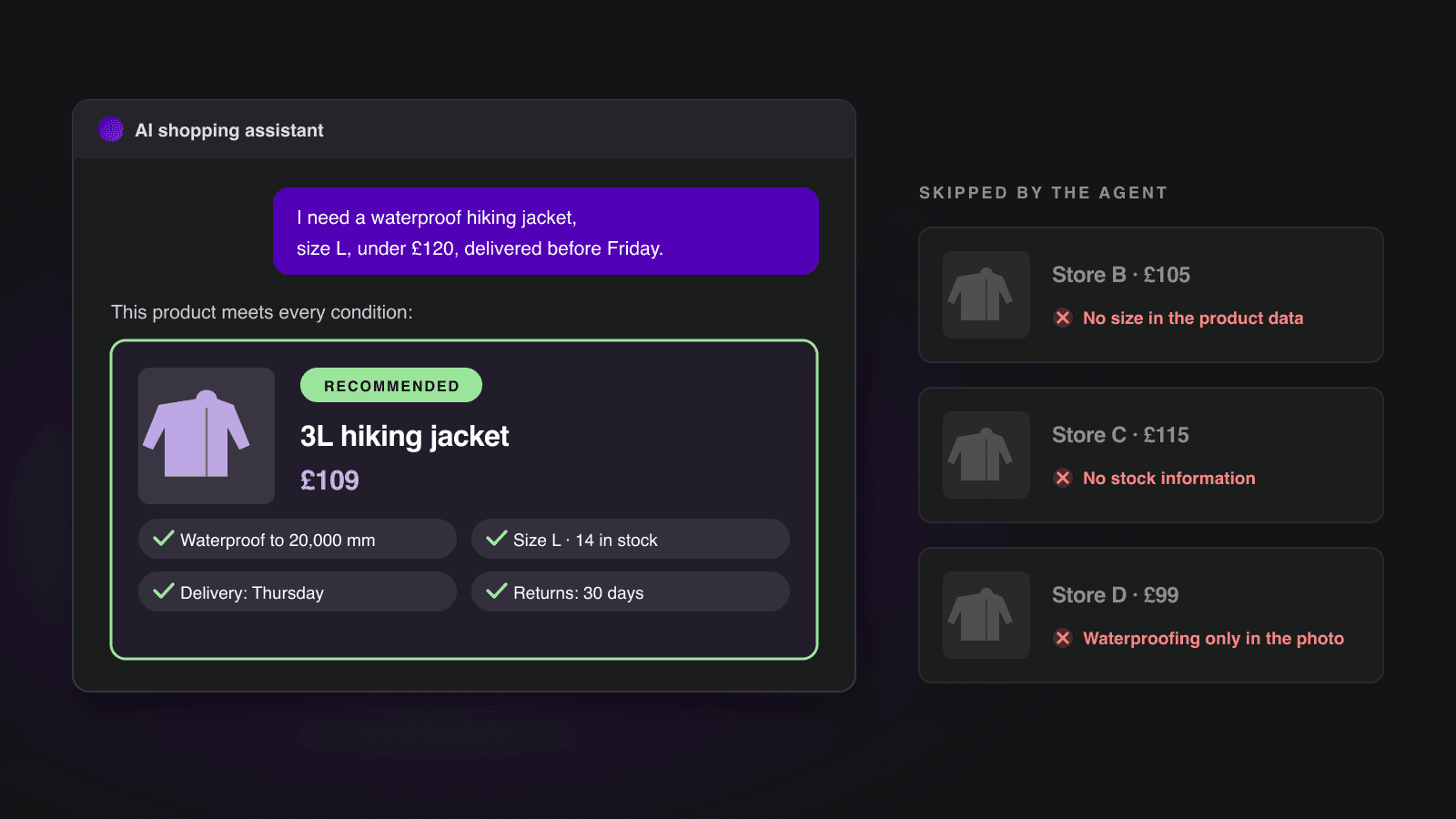
Researchers from Yale, Columbia and the University of Chicago tested how AI agents pick products. When a key attribute disappeared from a listing, that product’s chance of being chosen dropped by 20–40%. The agents didn’t fill in the missing information the way people do. They picked products with complete data in a form machines can read2.
Shopify sees the same thing in its numbers. Searches powered by Shopify Catalog, its structured data on more than a billion products, convert at twice the rate of general AI search11. Google puts it plainly:
Autonomous agents are only as reliable as the data behind them. Ashish Gupta, Google, announcing the partnership with NIQ
In your store it looks like this: waterproofing mentioned only on a photo of the label, sizes in a PDF, stock updated once a day. To a customer these are details, but they are exactly what makes an agent skip your product and recommend a competitor’s.
A badly described product comes back
Poor data also hurts when an agent does recommend the product. In September 2026 Blue Yonder surveyed more than 5,000 consumers in five countries. In the US, 46% of people who had bought something on an AI recommendation returned such a product within a year. The most common reason? The product was different from its description, said 36% of them14.
Blue Yonder’s CEO Duncan Angove gave a diagnosis I fully agree with:
It’s a data problem… most product data was written for a search bar, not for a machine suggesting products for someone. Duncan Angove, Blue Yonder, to Retail Dive
The agent repeats to the customer whatever it finds in your data. If the data is wrong, the customer orders something other than what they wanted, and the store pays for the return.
What agents expect from a store
What does this look like technically? The platforms have published their requirements:
- OpenAI requires nine fields in the feed, including a stable ID, title, description, brand, image, price and availability. A row without valid availability is rejected. Price has to be updated when a sale starts or ends, and availability when a product sells out15.
- Google, for agent checkout, requires a returns policy with the return cost, the return window and a link to the full terms. Products with non-standard delivery fees, such as freight for bulky items, can’t use agent checkout16.
- Shopify keeps uncategorised products out of its catalogue. It also notes that it classifies products from their product information, which can differ from the category the store set. Complete, accurate information helps it get this right17.
And outside the US? Agent checkout in Google currently works for merchants in the US, Canada and Australia18, and in Microsoft Copilot only for sales to US customers19. Ads in AI Mode haven’t reached Poland or the rest of the EU either20. But assistants already help customers choose products everywhere, in ChatGPT, in Gemini and on Allegro. That leaves you time to get your data in order before agent payments arrive too.
Where to start in your store
These requirements boil down to a few rules any store can put in place:
- Put in attributes what you now show only in photos. Material, dimensions, waterproofing, compatibility. An agent will always read a data field, but it can easily miss text on a photo of a label.
- Update price and availability straight away. A feed refreshed once a day will show an agent a product that's already gone, or a price that has just changed.
- Describe returns and delivery in the data. The return window, its cost and the delivery time each have their own fields in feeds.
- Give every product a category. Uncategorised products drop out of the catalogues agents use.
- Keep your data in one place. If your store, feed and marketplace carry three different descriptions, the agent may land on the weakest one.
- Check what the agent sees. Ask ChatGPT or Gemini about your products the way a customer would, and compare the answer with what you actually sell.
How we work with product data
For us, sorting out product data starts with a single source. We implement Pimcore as the home for all product data: descriptions, prices, attributes and images. You fix a description once, and the change reaches your store, your feeds and your marketplaces.
What usually takes the most time is importing supplier data, because every supplier sends it in a different format. This is where AI agents help us: they write scripts that map supplier files onto the product model. A developer sets the import rules and approves the exceptions. You can read more about how we combine AI with our team’s work on the AI in your company page.
If you remember one thing from this post, let it be this: an AI assistant will recommend your product only when it finds everything the customer asks about in your data.